How to Review Your Go Games with KataGo AI: Step-by-Step Beginner's Guide
Published on April 4, 2026 by StoneBase Team
Reviewing your games is the single most effective way to improve at Go. Every game you play contains lessons: missed opportunities, reading errors, strategic misjudgments. But those lessons are invisible unless you take the time to look for them.
This guide explains how to review your games effectively, whether you’re a beginner or an experienced player looking to sharpen your approach.
Why Review Games?
Playing games alone isn’t enough to improve. Many players repeat the same mistakes for years because they never stop to examine what went wrong. Game review helps you:
- Identify patterns in your mistakes. Do you lose the game in the opening, the middle game, or in fighting? Reviewing reveals where your weaknesses lie.
- Understand critical moments. Every game has 3-5 moments where the outcome shifted dramatically. Learning to recognize these moments is a key skill.
- Build your intuition. When you study the correct move in a position you got wrong, that understanding becomes part of your judgment for future games.
The Basic Review Process
1. Replay the Game from Memory
Before looking at any AI analysis, replay the game yourself. Try to remember what you were thinking at each move. This step is important because it connects the moves to your decision-making process.
As you replay, mark positions where you:
- Felt uncertain about the right move
- Knew you made a mistake but didn’t see a better option
- Were surprised by your opponent’s response
2. Look for Big Turning Points
Most Go games aren’t decided by a single move. They’re decided by 3-5 critical moments where the advantage shifted. These are the positions worth the most study time.
Signs of a turning point:
- A group that died unexpectedly
- A territorial framework that got invaded or reduced more than expected
- A fight where one side gained a significant advantage
- An endgame sequence that swung more points than it seemed
3. Use AI Analysis to Verify Your Thinking
This is where tools like StoneBase with KataGo become invaluable.
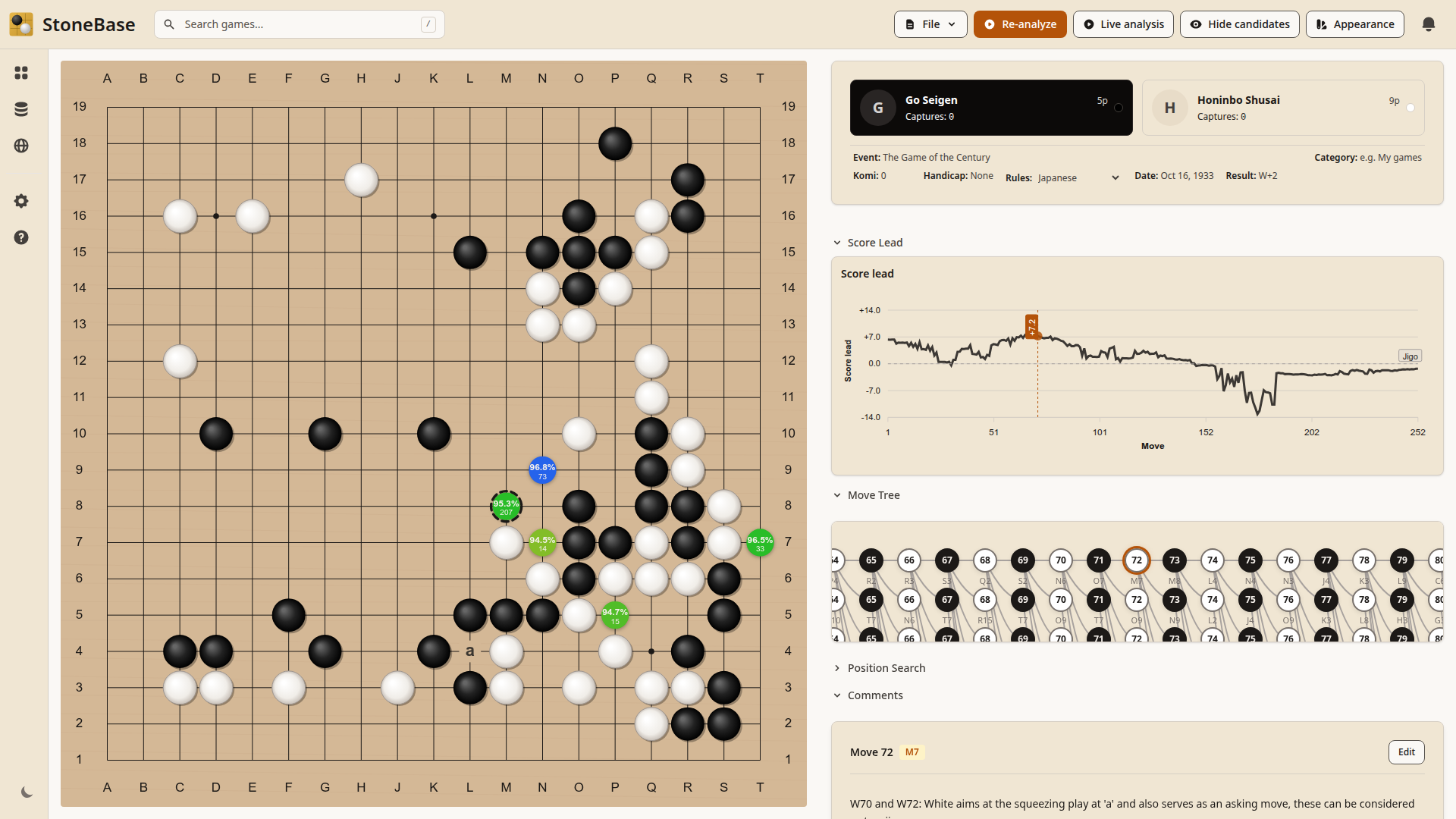
AI analysis gives you:
- Win rate graph: Shows exactly when the game’s balance shifted. A sudden drop in win rate pinpoints your biggest mistakes.
- Score estimates: Tells you how many points each mistake cost, helping you prioritize which errors to study.
- Candidate moves: Shows what the AI thinks were the best moves in each position. Compare these with what you played.
- Variations: Explore the AI’s suggested lines to understand why a move is better.
Don’t just look at the AI’s top suggestion. Try to understand why it’s better than what you played.
4. Focus on Understanding, Not Memorizing
The goal isn’t to memorize the AI’s moves. It’s to understand the principles behind them. Ask yourself:
- What was wrong with my move? Was it too slow? Too aggressive? In the wrong direction?
- What principle does the AI’s move follow? Is it about efficiency, thickness, timing?
- Can I apply this principle to other positions?
A single deeply understood mistake teaches you more than a hundred superficially noted ones.
Common Mistakes in Game Review
Reviewing too many games: Quality over quantity. One thoroughly reviewed game per week is worth more than skimming ten games.
Only looking at moves you got wrong: The moves you got right are also instructive. Understanding why a good move was good reinforces positive habits.
Fixating on AI disagreements in the opening: Opening moves often have very small differences in AI evaluation. Focus your energy on middle game mistakes where the point swings are larger.
Skipping the “replay from memory” step: Jumping straight to AI analysis disconnects the review from your thought process. The connection between what you were thinking and what was actually happening is where the learning lives.
Building a Review Habit
The most effective approach is to review consistently:
- Review your most important game each week. Pick the game where you felt most uncertain or where the result surprised you.
- Spend 30-60 minutes. Enough time to go deep on the critical moments, but not so long that you lose focus.
- Keep notes. Write down what you learned. Even a single sentence per game adds up over time. StoneBase lets you annotate moves directly in the game tree.
- Track your patterns. After reviewing several games, you’ll notice recurring themes. These are your priority areas for study.
Using StoneBase for Game Review
StoneBase is designed to support this entire workflow:
- Import your games from online servers or your local SGF collection
- Run AI analysis so KataGo evaluates every move with win rate and score estimates
- Navigate the win rate graph and click on it to jump to critical moments
- Explore variations by placing stones and seeing the AI’s evaluation of alternatives
- Add annotations to mark good moves, mistakes, and add comments for future reference
- Search by position to find similar positions across your game library
The combination of your own game sense and AI evaluation creates a feedback loop that accelerates improvement far beyond what either could achieve alone.
Related Articles
- How to Set Up KataGo for Go Game Analysis — Step-by-step guide to installing KataGo and connecting it to StoneBase.
- Understanding KataGo Win Rate and Score Estimates — Learn what the numbers mean and how to use them effectively.
- 5 Common Mistakes in Go and How AI Helps You Spot Them — The five most expensive mistake patterns and how to fix them.
- How to Import Your OGS Games into StoneBase — Bring your Online Go Server games into StoneBase for review.
Ready to analyze with AI?
If you haven't set up KataGo yet, check out our complete KataGo setup guide — it covers Windows, Mac, and Linux installation in minutes.