KataGo Win Rate & Score Explained: How to Read the Numbers
Published on April 2, 2026 by StoneBase Team
When you analyze a Go game with KataGo, two numbers dominate the display: win rate and score estimate. These are powerful tools for understanding your games, but they’re often misunderstood.
This article explains what these numbers mean, how they relate to each other, and how to use them effectively in your game review.
What Is Win Rate?
Win rate is KataGo’s estimate of the probability that a player will win the game from the current position, assuming both sides play at KataGo’s level from that point forward.
A win rate of 65% for Black means that if KataGo played both sides from this position, Black would win roughly 65 out of 100 games.
Key things to understand about win rate
It assumes perfect play from both sides. A position where you’re ahead but your lead depends on a difficult-to-find move will still show a high win rate, because KataGo would find that move. For human players, the practical win rate might be different.
It changes with komi and rules. Japanese rules and Chinese rules evaluate the same position differently. Make sure your analysis settings match the rules your game was played under, otherwise the win rate baseline will be off.
50% doesn’t mean “even” in all rulesets. With standard komi (6.5 or 7.5), Black often starts with slightly below 50% win rate because komi is designed to compensate for Black’s first-move advantage. A win rate around 45-50% for Black at the start of the game is normal.
What Is Score Estimate?
Score estimate is KataGo’s prediction of the final score difference, again assuming strong play from both sides. A score of B+3.5 means KataGo expects Black to win by about 3.5 points.
Score vs. win rate: when do they disagree?
Usually, win rate and score move together. But sometimes you’ll see a position where the score lead is large but the win rate is only slightly above 50%, or vice versa.
This happens because:
- Close games with high certainty: If KataGo is very confident the score will be B+0.5, the win rate might be 95%+ even though the score lead is tiny. The game is close in points but the outcome is nearly decided.
- Large leads with uncertainty: A position where Black might win by 20 points or lose by 10 depending on a complicated fight could show a moderate win rate despite a high average score estimate.
For game review, score estimate is often more useful than win rate for understanding the size of a mistake. A move that drops your win rate from 80% to 60% might be a 2-point mistake or a 15-point mistake. The score estimate tells you which.
Reading the Win Rate Graph
In StoneBase, the win rate graph shows how the game’s balance shifted move by move.
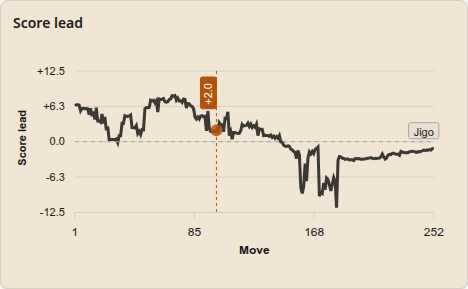
Here’s how to read it effectively:
Look for sharp drops
A sudden drop in win rate (say, from 60% to 35%) marks a significant mistake. These are the moves you should study most carefully. Click on the drop point to jump directly to that position.
Distinguish between mistakes and inevitable swings
Not every win rate change represents a mistake. In fighting positions, win rate naturally swings back and forth as the AI’s evaluation updates with each move. A sequence where win rate goes 55% → 45% → 55% → 48% might just be a normal fight where both sides played reasonably.
The mistakes that matter are one-sided drops: positions where you lost significant ground and never recovered it.
Don’t obsess over small fluctuations
A win rate change of 1-3% usually represents a very small inaccuracy. At amateur level, these are not worth studying. Focus your energy on drops of 10% or more. Those are the moves where you gave away the most.
How Many Visits Matter?
KataGo’s evaluation becomes more accurate with more visits (the number of positions it analyzes). Here’s a rough guide:
- 100-200 visits: Quick evaluation. Good for getting a general sense of the position but may miss tactical details.
- 500-1000 visits: Solid evaluation for most game review purposes. This is the sweet spot for casual analysis.
- 2000+ visits: Deep analysis. Useful for studying specific critical positions in detail but takes more time.
For a full game review, 500 visits per move is usually sufficient. You can then increase visits on specific positions that interest you.
Practical Tips for Using AI Evaluation
Don’t just look at the numbers. Explore the variations. The win rate tells you that a move was a mistake, but understanding why requires looking at KataGo’s suggested continuation. What did the AI expect to happen? How does it differ from what you were planning?
Compare your move with the top 2-3 suggestions. Sometimes your move is the AI’s second choice, losing only 0.5 points compared to the best move. That’s a perfectly reasonable move for a human. Other times, your move isn’t in the top 10, and that’s where the real learning happens.
Pay attention to the direction of play. When the AI suggests a move in a completely different area of the board, it’s not just saying “this move is better.” It’s saying the most important area of the board is somewhere you weren’t looking. Learning to identify the biggest area is one of the most impactful skills in Go.
Use score estimate to prioritize your review. A 20-point mistake in the opening deserves more study than a 2-point endgame inaccuracy. The score estimate helps you spend your review time where it has the most impact.
Related Articles
- How to Review Your Go Games: A Beginner’s Guide — A complete workflow for reviewing your games effectively.
- How to Set Up KataGo for Go Game Analysis — Get KataGo running with StoneBase on any platform.
- 5 Common Mistakes in Go and How AI Helps You Spot Them — See win rate and score analysis in action on real mistake patterns.
Ready to analyze with AI?
If you haven't set up KataGo yet, check out our complete KataGo setup guide — it covers Windows, Mac, and Linux installation in minutes.