How to Search Your Go Game Collection by Board Position
Published on March 25, 2026 by StoneBase Team
Have you ever been in a game and thought, “I’ve seen this position before, what happened last time?” Position search lets you answer that question instantly by finding all games in your collection that contain a specific board pattern.
This is one of the most powerful features for serious Go study, and one that has historically only been available in expensive professional databases. With StoneBase, it’s available to every player.
What Is Position Search?
Position search lets you place stones on a board to define a pattern, then search your entire game library for games that contain that exact position. It finds every game where those stones appeared in those locations, regardless of move order.
For example, you could:
- Place a 3-4 point stone with an approach and a pincer, then find every game where that joseki position occurred
- Set up an opening pattern to see how your games from that fuseki turned out
- Place a corner position to study different responses you or your opponents have played
Why Position Search Matters
Study your own patterns
Over hundreds of games, you develop habitual responses to common positions. Position search lets you see all your games with a particular pattern side by side. Are you winning with your usual joseki choice? Are you consistently losing from a certain opening? The data tells you what your intuition might miss.
Learn from professional games
If you’ve imported a collection of professional games, position search becomes a fuseki encyclopedia. Place the opening moves from your game and see how professionals handled the same position. This is how players have studied Go for decades, but with a digital collection, the search is instant.
Prepare against opponents
If you have your opponent’s games in your library, you can search for their favorite openings and study how they handle specific positions. This kind of preparation is common among professional players and can give you an edge in tournament games.
How Position Search Works in StoneBase
Setting up a search
- Open the Position Search panel
- Place stones on the board to define the pattern you want to find. You can place both black and white stones.
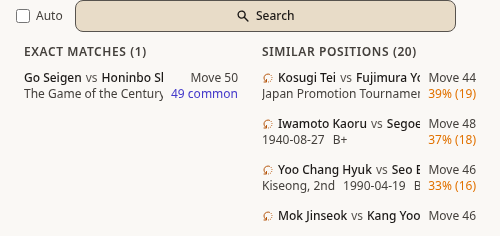
- Click Search. StoneBase scans your entire library and returns matching games.
The search finds all games where the specified stones are present on the board at any point during the game. It doesn’t matter what move number they were played on or what order they were placed.
Working with results
When StoneBase returns matching games, you can:
- See the count: Know how many games in your collection reached this position
- Browse the matches: Click on any result to open that game at the matching position
- Analyze continuations: See what moves were played next across all matching games
- Filter results: Combine position search with other filters like player name, date range, or result
Tips for effective searches
Start broad, then narrow down. Begin with just a few key stones that define the pattern. If you get too many results, add more stones to make the pattern more specific.
Use corner positions. Corners are where the most repeatable patterns occur in Go. A joseki position in the corner might appear in hundreds of your games, giving you meaningful data about your performance.
Search for positions you struggle with. If there’s a joseki or fuseki you keep losing from, search for it and study the games. Look at what happened differently in the games you won vs. the ones you lost.
Don’t forget about your opponent’s perspective. Try searching for positions from your opponent’s point of view. If you’re studying a particular invasion, search for the position to see how others defended against it.
Building a Useful Game Collection
Position search becomes more powerful as your game collection grows. Here are some ways to build a collection that makes search more valuable:
- Import all your online games. Most Go servers let you download your game history as SGF files. Import them all into StoneBase.
- Add professional game collections. Large databases of professional games are available online. These give you reference material for almost any position.
- Save interesting games you come across. When you see an instructive game in a lecture or stream, save the SGF and add it to your library.
- Organize with metadata. Tag games with player names, events, and dates so you can combine position search with other filters.
Position Search vs. Pattern Databases
You might be familiar with online joseki dictionaries or pattern databases. These are useful, but position search in your own game collection offers something different:
- Your actual games: Not theoretical joseki, but positions you actually reached and had to handle
- Your results: You can see whether you won or lost from this position, giving you practical feedback
- Context: Each matching game shows you the full context, including what happened before and after the position and how the game developed from there
The best approach is to use both: consult joseki databases for theoretical knowledge, and use position search on your own games for practical feedback on how well you execute that knowledge.
Related Articles
- How to Review Your Go Games: A Beginner’s Guide — Combine position search with AI analysis for a complete review workflow.
- 5 Common Mistakes in Go and How AI Helps You Spot Them — Use position search to find games where you repeat the same mistakes.
- How to Set Up KataGo for Go Game Analysis — Get started with AI analysis alongside position search.
Ready to analyze with AI?
If you haven't set up KataGo yet, check out our complete KataGo setup guide — it covers Windows, Mac, and Linux installation in minutes.